Tissue-resident memory CD4+ T cells (TRM) are important immune mediators of allergy and autoimmunity that reside in non-lymphoid tissues, including the lung. In this study, we profiled TRM cells in the lungs of mice before and after house dust mite exposure, and deeply characterized the TRM localization and gene expression in situ. This analysis revealed the PD1 pathway as a crucial regulator in tertiary lymphoid structure (TLS) development. TLS are lymphoid organs that form in tissues in the setting of chronic inflammation that organize inflammatory and immune responses.
Full details of this study can be found in our article on bioRxiv:
Bangs DJ, Hondowicz B, Abadie K, Savard R, Weiss M, Karakousi T, et al. Tertiary lymphoid structures support the development of allergen-specific progenitor CD4+ T cells. bioRxiv. 2025. p. 2025.10.03.680350. doi:10.1101/2025.10.03.680350
As part of this study, we performed 10x Genomics Xenium spatial transcriptomic profiling of mouse lung tissues prior to and after dust mite exposure. We provide an interactive visualization tool to enable open exploration of this data below:
Lung TLS Spatial Explorer
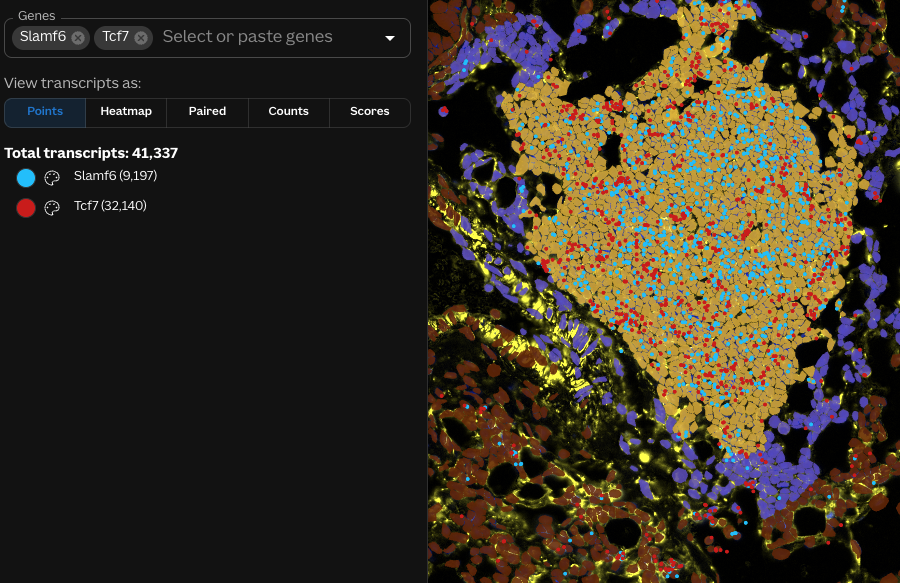
Explore TLS development in lung tissue at Day 3 and Day 30, including gene expression, positioning relative to TLS and bronchi, and immunofluorescence layers.
Explore Spatial Dataset