Antibody-secreting cells (ASCs) are differentiated B cells that provide protective humoral immunity in the context of vaccination and infection and pathogenic immunity in the context of autoimmunity and multiple myeloma, an ASC malignancy. Most ASCs survive only hours or days after differentiation, but a fraction persist in the bone marrow (BM) and other tissues for years. Current classifications cannot delineate the heterogenous functionalities, tissue residencies, and lifespans of human ASC subsets, impeding clinical translation.
To identify a data-driven delineation of human ASC subsets, we applied CITE-seq with a custom 174-antibody panel to healthy adult BM samples and discovered five ASC subsets. We characterized their transcriptional profiles and applied trimodal TEA-seq (capturing 186 surface proteins, transcriptomics, and chromatin accessibility) to healthy adult BM samples to discover differential transcriptional regulators from epigenetic data. We also applied spatial proteomics and functional assays to discover and characterize human BM ASC subsets.
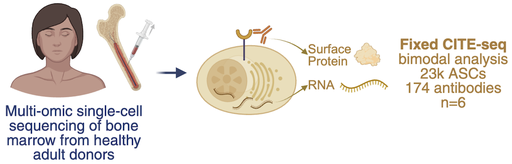
We identified two peripheral subsets (ASCp) also present in blood and three BM-resident subsets (ASCr), comprising a maturation continuum associated with increased mitochondrial networking, diminished antibody secretion, differential transcription factor motif accessibility, and preferential co-localization in homotypic niches. CD19+9+ASCr and CD19-ASCr exhibited poor recovery years after BM transplantation, indicating a strong dependence on supportive niches. Childhood vaccine antigens were recognized by long-lived ASCr subsets in adults, as well by immature HLA DR+ASCp, implying ASCs can differentiate without recent antigen exposure. Our results provide new insights into ASC identity, maturation, and longevity and a generalizable framework for study and manipulation of human ASCs.
Complete details of our study and analyses are available in our preprint on bioRxiv:
Glass DR, Dornisch E, Yin H, Ludmann SA, Samudre A, Kuhl S, et al. Multi-omic profiling of human antibody-secreting cells reveals diverse subsets sustain durable humoral immunity. bioRxiv. 2026. p. 2026.04.13.717827.
doi:10.64898/2026.04.13.717827
To enable exploration of this unique dataset, we provide the following interactive visualization tools:
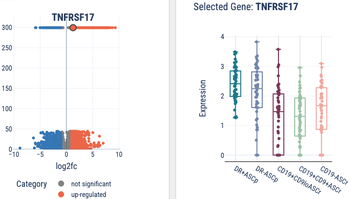
Examine cell type-specific differences in gene expression due to age group, CMV infection status, or biological sex.
Explore Differential Expression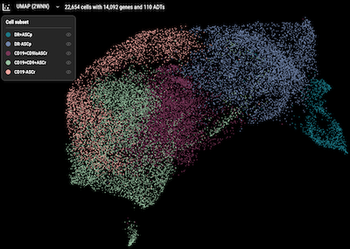
Explore the diversity of antibody-secreting cells from healthy bone marrow with both transcriptomic and cell surface marker expression.
Explore ASC UMAP